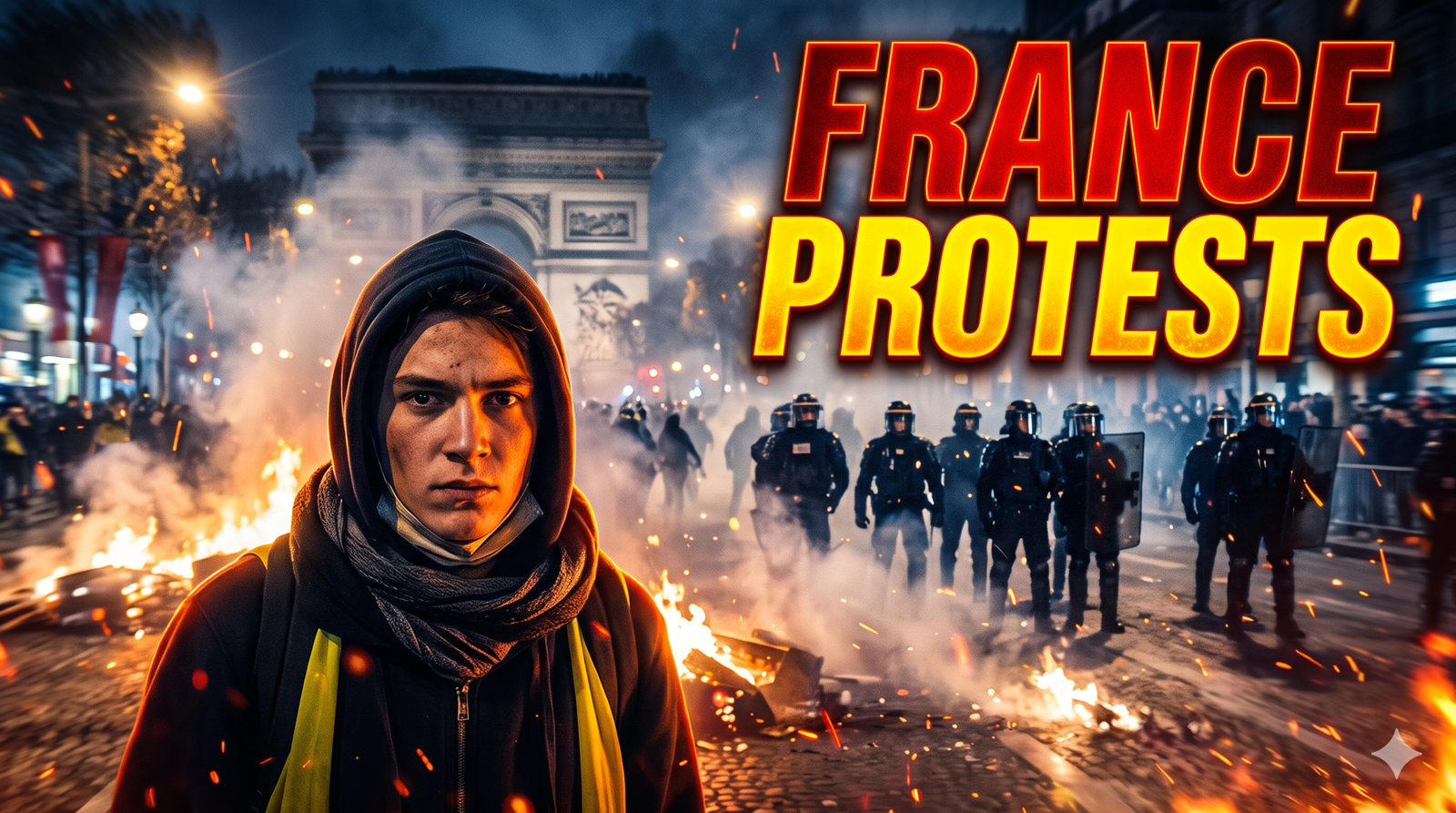
In France, public protest is far more than a tool of last resort—it is a central pillar of democratic culture and civic identity, widely seen as a legitimate counterweight to the powerful, centralized executive established under the Fifth Republic. From the barricades of the 1789 Revolution and the seismic general strike of May 1968 to modern revolts over pensions, fuel taxes, and living costs, the French street remains one of the world’s most potent arenas for political contestation.
To understand why protests in France are so frequent, passionate, and often disruptive, one must examine the country’s distinct political framework, the deep-seated socioeconomic grievances of its citizenry, and the complex dynamics between organized labor, grassroots movements, and state security forces.
1. The Institutional Roots: A Hyper-Centralized Republic
The structure of French governance itself plays a decisive role in channeling political debate onto the streets. Under the Constitution of the Fifth Republic, designed in 1958 by Charles de Gaulle, the French President possesses vast executive powers compared to leaders in parliamentary democracies.
When a sitting administration pursues controversial legislation without broad parliamentary compromise, voters often feel that standard institutional channels offer few avenues for recourse. Mechanisms such as Article 49.3—which permits the executive to pass legislation without a parliamentary vote unless a motion of no-confidence succeeds—have frequently bypassed legislative debate on major fiscal and labor reforms.
Consequently, when citizens perceive the National Assembly as sidelined or deadlocked, the street becomes the primary forum where power can be directly challenged. The slogan “la rue gouverne” (the street governs) reflects a shared civic belief that mass mobilization is necessary to check an otherwise unyielding executive branch.
2. The Core Drivers of Modern Unrest
While French protests frequently erupt over specific government initiatives, they invariably tap into deeper, interconnected economic and social grievances:
A. Purchasing Power and the Cost of Living (Pouvoir d’Achat)
Economic anxiety remains the most reliable catalyst for broad mobilization. Whether triggered by fuel price hikes, utility costs, or consumer inflation, French households—particularly outside major metropolitan hubs—feel an acute squeeze on purchasing power. The divide between thriving globalized cities like Paris and the rural/semi-rural périphérie fueled the Gilets Jaunes (Yellow Vests) movement, proving that localized consumer anger can rapidly evolve into an existential challenge to the political elite.
B. Defense of the Social Contract and Public Services
The French social model is anchored in universal healthcare, accessible higher education, subsidized public transport, and robust safety nets. Citizens view these services as rights earned through taxation rather than discretionary state benefits. When hospital wards face austerity, schools experience persistent understaffing, or regional rail branches close, protests erupt to defend the public sphere against state retrenchment and neoliberal restructuring.
C. Labor and Pension Reforms
The French retirement system and labor code represent ideological red lines. Protests against raising the statutory retirement age, curtailing unemployment insurance, or liberalizing employment protections consistently draw millions into the streets. In the French view, productivity gains should translate into leisure, dignity in old age, and well-being, rather than extended working years dictated by credit-rating agencies or budgetary constraints.
D. Systemic Discrimination and Police Brutality
Urban unrest periodically flares in the banlieues (low-income suburbs ringed around major cities). Sparked by incidents of lethal force during police stops, these uprisings reflect generational resentment over systemic disenfranchisement, racial profiling, poor infrastructure, and lack of social mobility. These clashes often diverge significantly from union-led demonstrations, taking the form of spontaneous, decentralized riots targeting symbols of state authority.
3. Key Actors in the Mobilization Machine
A French protest movement is rarely monolithic; it typically brings together distinct groups with differing strategies, organizational structures, and end goals:
| Actor | Primary Base | Typical Tactics | Strategic Objectives |
| Trade Unions (CGT, CFDT, FO) | Public sector workers, transit employees, teachers, heavy industry | Coordinated nationwide strike days (journées d’action), transport blockades | Negotiated policy concessions, wage hikes, protection of labor statutes |
| Student & Youth Groups | High schoolers (lycéens) and university students | School blockades, campus occupations, vanguard march contingents | Educational funding, youth welfare, climate action, future labor rights |
| Grassroots / Peripheral Blocs | Suburban commuters, rural workers, small business owners | Roundabout occupations, localized toll blockades, unheralded marches | Reduction of regressive taxes, direct democracy, cost-of-living relief |
| Autonomous & Radical Factions | Black Blocs, anti-capitalist collectives | Direct action, property damage targeting corporate targets, clash tactics | Confrontation with police, subversion of capitalist and state infrastructure |
4. Tactics, Disruption, and Policing Strategies
French demonstrations are renowned for their economic and physical disruption. Trade unions frequently target strategic chokepoints:
- Transport Shut-Offs: Halting SNCF trains, Paris Metro lines, and air traffic to paralyze commercial life.
- Energy Disruptions: Striking workers at oil refineries and electricity substations choke fuel distribution and impose symbolic power cuts.
- Urban Blockades: Garbage collectors leaving hundreds of tons of waste uncollected across major boulevards, creating immediate public and political pressure.
In response, state authorities deploy heavily equipped specialized police units, including the CRS (Republican Security Companies) and BRAV-M (motorized police brigades). The state’s reliance on crowd-control munitions—such as tear gas, flash-balls (LBDs), and stun grenades—has drawn sharp criticism from domestic civil liberties organizations, the UN, and the Council of Europe for causing severe injuries to protesters. High-friction policing often escalates peaceful marches into running street battles, reinforcing cycles of mutual distrust.
5. Wider Political Impact and Democratic Paradox
Mass protests in France yield substantial real-world consequences, but they also expose a growing democratic paradox.
On one hand, the street has achieved historic victories: scuttling unpopular bills (such as the 2006 First Employment Contract), compelling emergency fiscal packages (such as the billions allocated during the peak of the Yellow Vests unrest), and maintaining some of Europe’s strongest social protections. Protesting gives voice to non-electoral majorities between five-year election cycles.
On the other hand, the recurrent cycle of street mobilization reflects an increasingly polarized and paralyzed political system. When citizens conclude that normal voting achieves little and the state can bypass parliamentary consensus, demonstrations become the only perceived avenue to exert influence. As mainstream political parties fragment and trust in democratic institutions declines, social unrest increasingly spills into electoral surges for populist, far-left, and far-right alternatives.
Conclusion
The French protest tradition is neither random disorder nor mere political theater; it is a fundamental pillar of how power is negotiated in France. As economic pressures, fiscal consolidation, and cost-of-living crises continue to test the post-war welfare state, the French street remains an ever-present, volatile arbiter—ready to mobilize whenever citizens perceive the social compact to be under threat.
Would you like a focused examination of a specific historical movement (such as May 1968 or the Gilets Jaunes), or an analysis of current parliamentary and electoral dynamics in France?