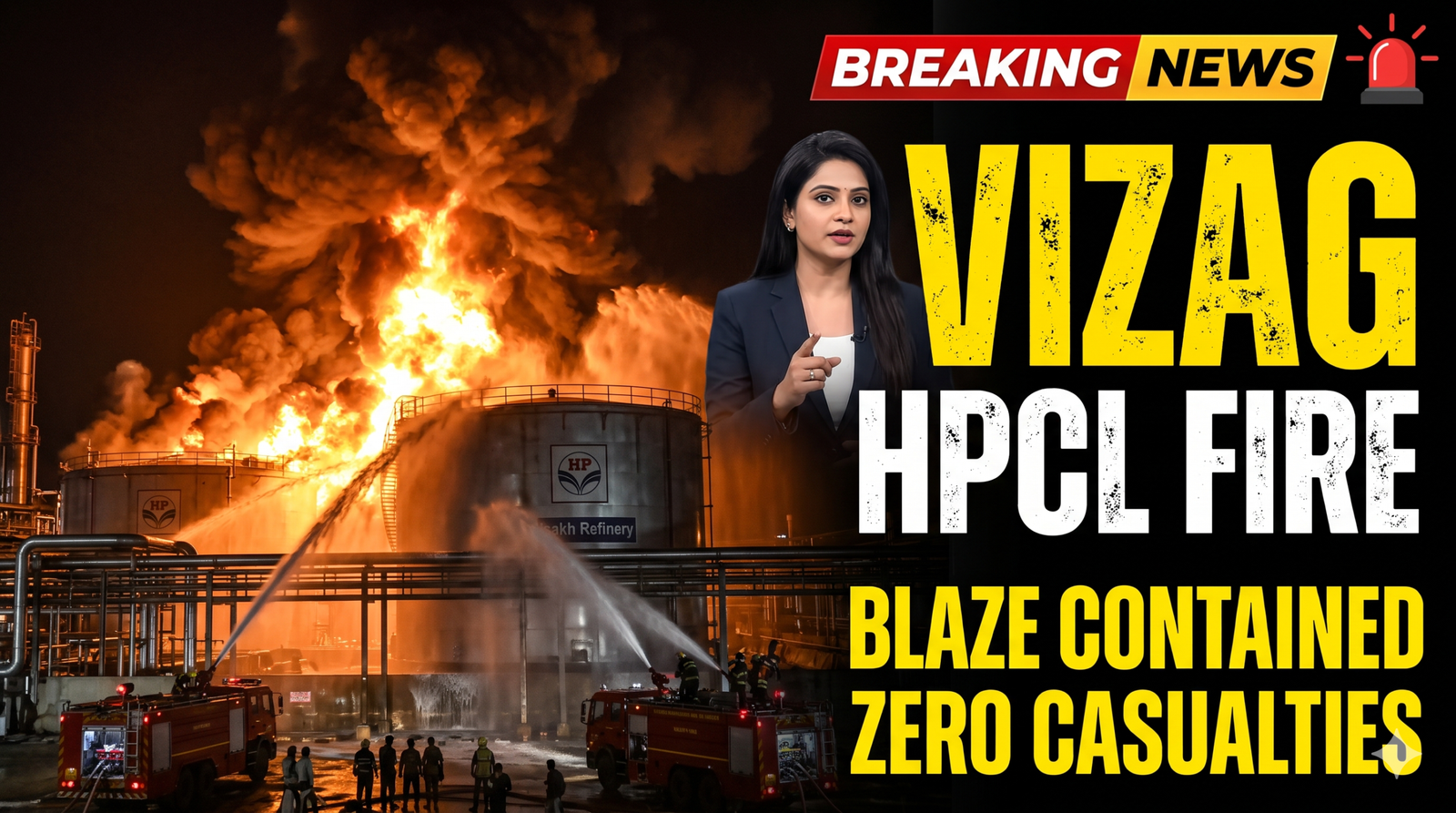
A major industrial fire broke out late Monday evening at the Hindustan Petroleum Corporation Limited (HPCL) Visakhapatnam refinery complex, sending towering flames into the night sky and billowing thick clouds of black smoke across nearby residential areas. The incident occurred around 10:00 PM when a localized blaze erupted in a storage tank area holding pitch and residue products.
Emergency response teams, industrial fire brigades, and local civil authorities mobilized swiftly, containing the fire directly within the affected unit and preventing it from spreading to adjacent refining installations. Official statements confirmed there were no fatalities or injuries, and all critical processing units continue to operate under safe parameters.
Chronology of the Incident
Around 10:00 PM on Monday night, local workers and residents living along the industrial corridor of Malkapuram, Sriharipuram, and Scindia reported loud rumblings and a sudden flash illuminating the skyline. Within moments, a dense column of black smoke rose into the air.
- Origin Point: The fire broke out within a residue handling storage tank containing residue upgradation facility (RUF) pitch oil, an intermediate heavy petroleum residue utilized primarily in bitumen production.
- Immediate Response: Internal refinery siren alarms sounded instantly, initiating standard on-site disaster management protocols. Internal emergency teams isolated the feed lines to the affected tank to starve the combustion source.
- Firefighting Mobilization: Multiple dedicated industrial foam tenders and water monitors from HPCL’s internal firefighting force, bolstered by units from the Visakhapatnam Port Authority and the Eastern Naval Command, arrived on the scene within minutes.
- Containment: Through high-volume foam blanketing and external water cooling of adjacent tanks, crews brought the blaze under control before it could penetrate neighboring petrochemical units or pipeline racks.
Community Impact and Public Safety
Because the refinery borders densely populated industrial worker colonies and coastal neighborhoods, the visibility of the flames triggered widespread panic. Social media feeds rapidly filled with video footage of the towering fire, prompting rumors of a catastrophic tank explosion.
Visakhapatnam City Police Commissioner Shankhabrata Bagchi and senior municipal administration officials deployed law enforcement personnel to control access roads, regulate traffic along the Scindia-Malkapuram highway, and address public concerns. Police loudspeakers and verified broadcasts urged citizens not to succumb to panic or believe unverified evacuation rumors, reassuring residents that the incident was strictly confined to an isolated storage pitch tank.
Refinery medical centers confirmed that zero personnel sustained burns or severe smoke inhalation. Nearby hospitals placed emergency casualty wards on standby, but no injured workers or civilian casualties were admitted.
Ongoing Investigation and Cause Analysis
Technical experts, along with safety auditors from the Directorate General of Factory Inspection and internal safety regulators, have commenced an investigation into the mechanical and operational triggers behind the ignition.
| Investigation Parameter | Current Finding / Status |
| Material Involved | RUF Pitch / heavy residue pitch storage tank |
| Suspected Ignition Source | Suspected vapor build-up, seal leakage, or high-temperature line failure (subject to final forensic audit) |
| Structural Damage | Confined strictly to the exterior insulation, piping, and shell of the pitch tank |
| Environmental Impact | Heavy local soot and particulate fallout; ambient air monitoring stations reported no toxic volatile organic compound (VOC) spike |
| Operational Impact | Primary crude distillation units and allied refining trains continue steady operations |
While industrial rumors suggested an internal pressure blast, preliminary assessments indicate the damage was primarily driven by surface-level vapor combustion rather than a catastrophic structural tank rupture.
Industrial Context and Regulatory Lessons
Visakhapatnam serves as a vital eastern petrochemical and energy hub, hosting massive refineries, fertilizer complexes, and bulk liquid chemical terminals. However, the geographic proximity between these mega-plants and residential settlements means industrial accidents draw immediate scrutiny.
Following historical industrial disasters in the region—notably the 1997 HPCL LPG storage blast and the 2020 LG Polymers styrene gas leak—regulatory authorities have mandated rigorous layered safety systems:
- Automated Deluge and Foam Injections: Rapid-actuation foam systems proved critical during this event, blanketing the burning hydrocarbons within minutes and cutting off atmospheric oxygen.
- Inter-Agency Mutual Aid Schemes: The immediate co-deployment of emergency resources from nearby port facilities, naval bases, and adjacent public sector units prevented an escalation that could have overwhelmed a single internal safety brigade.
- Real-Time Public Communication: Timely releases of verified statements by factory representatives and the city police commissioner counteracted online misinformation, keeping civil order intact.
The HPCL pitch tank fire serves as a stark reminder of the continuous vigilance required in high-hazard hydrocarbon storage. As root-cause analysis reports finalize, industry leaders and regional authorities are preparing further reviews on vapor recovery systems, thermal insulation checks, and perimeter sensor networks to ensure such containment protocols continue protecting both workers and the surrounding metropolis.