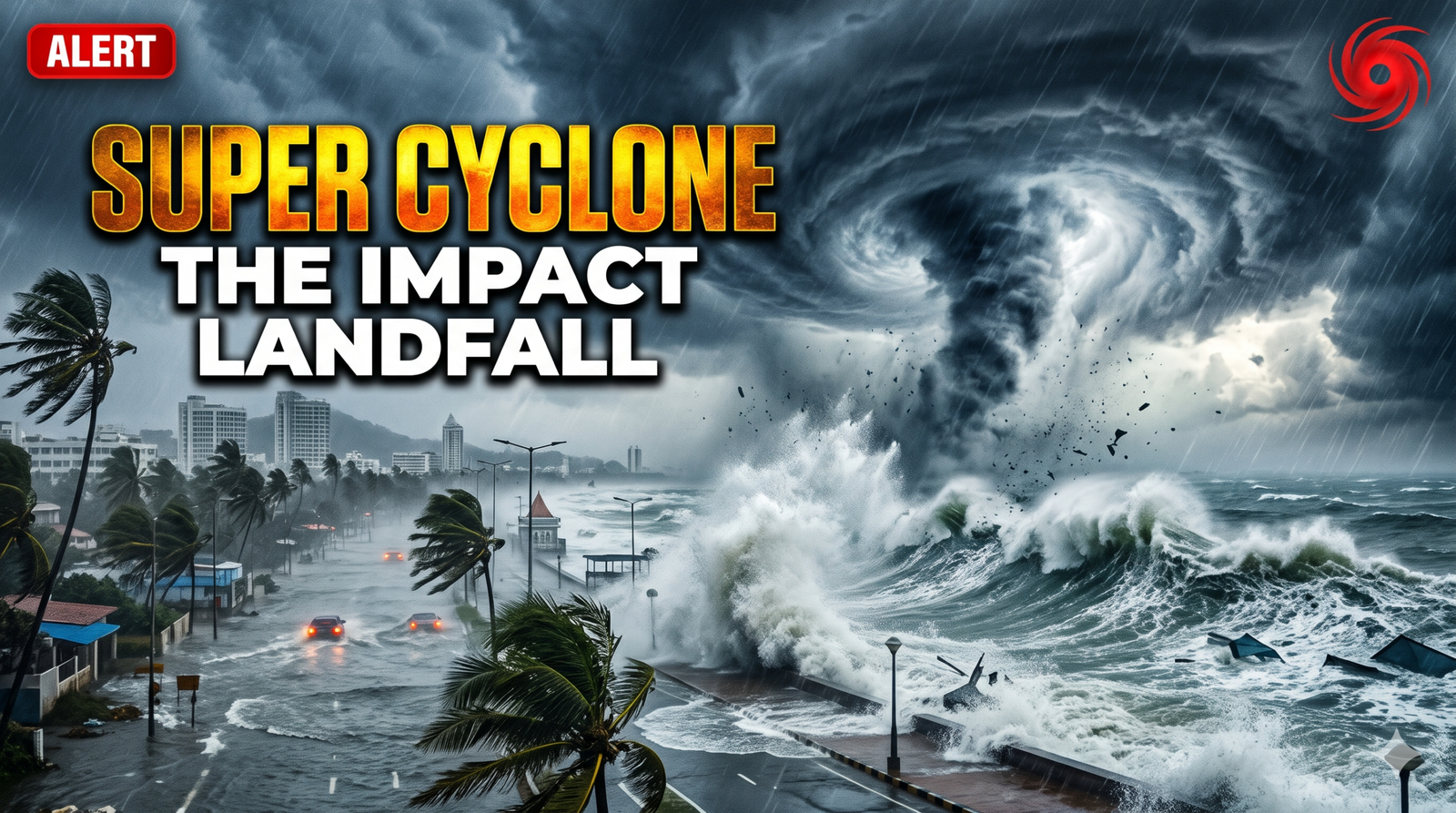
The Day the Port City Stood Still: Visakhapatnam and the Fury of Cyclone Hudhud
Visakhapatnam, affectionately known as Vizag or the “City of Destiny,” is celebrated for its scenic coastline, rolling Eastern Ghats, thriving industrial hubs, and lush urban canopy. Nestled along the Bay of Bengal, the city has long lived with the rhythm of the ocean. However, that proximity turned cataclysmic on October 12, 2014, when Extremely Severe Cyclonic Storm (ESCS) Hudhud made direct landfall over the city. It was a watershed moment in India’s disaster management history—the first time in modern records that a major metropolitan industrial harbor faced a direct, full-force hit from the eye of a high-category tropical cyclone.
1. Genesis and Trajectory of the Storm
Cyclone Hudhud originated from a low-pressure disturbance in the Andaman Sea in early October 2014. Fed by unusually warm sea-surface temperatures (around 29°C to 30°C) and low vertical wind shear across the Bay of Bengal, the system intensified rapidly. The India Meteorological Department (IMD) upgraded it through subsequent classifications—from deep depression to cyclonic storm, very severe cyclonic storm, and finally an extremely severe cyclonic storm.
By the time Hudhud approached the Andhra coast on October 11, its central pressure had plunged to nearly 950 hPa. Around noon on Sunday, October 12, the eyewall of Hudhud made direct landfall precisely over Visakhapatnam. Sustained surface winds reached 175 to 185 km/h, with ferocious localized gusts peaking at an astonishing 260 km/h recorded before weather radar domes were violently blown off their mountings.
A peculiar and eerie facet of Hudhud was the passage of the eye. For nearly 45 minutes to an hour, winds dropped to near-stillness, the torrential rain subsided, and daylight broke through, misleading many residents into believing the storm had passed. Soon after, the trailing edge of the eyewall crashed through from the opposite direction with equal or greater ferocity, tearing down already weakened structures.
2. Immediate Impact and Urban Devastation
The scale of direct physical devastation was unprecedented for an Indian urban core. While early warnings and massive pre-emptive evacuations kept the death toll remarkably low compared to historical benchmarks (around 46 fatalities in Andhra Pradesh), the structural destruction was staggering:
- The Loss of Urban Greenery: Within six hours, Vizag’s dense canopy was obliterated. Tens of thousands of mature trees along major avenues, the Andhra University campus, Kailasagiri hill park, and residential colonies were uprooted or snapped clean in half. The city went from emerald green to barren brown overnight.
- Critical Infrastructure Collapse: Visakhapatnam Airport looked like a war zone—its passenger terminal roof collapsed, glass walls shattered, radar communication systems were torn apart, and the runway was submerged. Operations at the headquarters of the Indian Navy’s Eastern Naval Command, the Visakhapatnam Port Trust, and Gangavaram Port were paralyzed.
- Industrial and Commercial Losses: Major state and central public sector undertakings, including the Visakhapatnam Steel Plant (Rashtriya Ispat Nigam Ltd.), HPCL Refinery, and Bharat Heavy Plate & Vessels (BHPV), sustained heavy roof, warehouse, and machinery damage, losing power and halting production for days.
- Communications and Power Blackout: Over 40,000 electricity poles and thousands of distribution transformers buckled under the wind forces. Sub-stations flooded, cellphone towers collapsed, and underground fiber-optic cables ruptured, cutting the city off from all voice and digital communication with the outside world for several days.
3. The Humanitarian Crisis in the Aftermath
In the days immediately following October 12, Visakhapatnam faced an acute civic emergency:
   ┌────────────────────────────────────────────────────────┐
   │             KEY IMPACT METRICS: CYCLONE HUDHUD         │
   ├───────────────────────────────┬────────────────────────┤
   │ Maximum Wind Gusts Recorded   │ ~260 km/h              │
   │ Storm Surge                   │ 1.2 – 1.4 meters       │
   │ Evacuations Conducted         │ >500,000 people        │
   │ Total Economic Loss           │ ~₹21,900+ Cr ($11B)    │
   │ Tree Canopy Loss in City      │ Over 50–60%            │
   └───────────────────────────────┴────────────────────────┘
With the electrical grid knocked out, apartment complexes and individual homes lost piped municipal water supplies. Diesel for backup generators grew scarce as fuel pumps lacked the electricity to dispense fuel. Residents had to queue for hours for basic drinking water, milk, and bread. Coastal fishing settlements, such as Chepalappada and Lawson’s Bay, had their mechanized boats shattered against seawalls and their dwelling units flattened by the 1.4-meter storm surge and pounding waves.
The total economic damages across Andhra Pradesh—encompassing agriculture, housing, industries, and municipal assets—exceeded ₹21,900 crore (over $11 billion in international assessments), marking Hudhud as one of the costliest natural disasters in the nation’s history.
4. Relief, Mobilization, and Administrative Tenacity
The response to Hudhud became a case study in crisis governance. Andhra Pradesh’s administrative leadership set up a makeshift base of operations inside a bus directly in Visakhapatnam to oversee relief in real time.
- Military and Paramilitary Aid: The National Disaster Response Force (NDRF), Indian Army, and Indian Navy launched relief operations (including the Navy’s Operation Lehar). Naval choppers air-dropped food and clean water packets, while Navy clearance diving teams and engineering regiments cleared arterial roads blocked by thousands of fallen banyan and gulmohar trees.
- Restoration of Power and Water: Linemen and technicians were brought in from neighboring states like Odisha, Telangana, and Tamil Nadu to re-erect poles and re-string high-tension transmission wires around the clock.
- Public-Private Community Solidarity: Local youth clubs, educational institutions, NGOs, and residential welfare associations organized community kitchens to feed stranded citizens and slum dwellers, preventing social breakdown during the week-long recovery window.
5. Lessons Learned and Building Resilience
Cyclone Hudhud fundamentally altered how coastal Indian cities plan for urban climate hazards:
- Underground Cabling: The catastrophic loss of power lines spurred Andhra Pradesh to initiate large-scale underground power transmission cable projects in Vizag, safeguarding lines against hurricane-speed winds.
- Disaster-Resilient Building Codes: Industrial units, coastal real estate developments, and government airports upgraded building standards to mandate wind-load designs capable of withstanding gusts up to 250+ km/h.
- Reforestation with Indigenous Species: The rapid uprooting showed that non-native, brittle trees like peltophorum and eucalyptus were liabilities during high winds. Subsequent massive replanting initiatives (“Green Visakha”) prioritized deep-rooting, wind-tolerant native coastal trees like neem, tamarind, and jamun.
- Early Warning Infrastructure: Doppler weather radars were overhauled and fortified, while mobile-alert systems (Common Alerting Protocol) were institutionalized to transmit geo-targeted warnings before future storms (such as Cyclones Titli, Gulab, and Michaung) arrived.
Conclusion
Cyclone Hudhud was a severe trial for Visakhapatnam, leaving deep scars on its natural environment and testing its civil infrastructure to its limits. Yet the defining narrative of the disaster was the indomitable resilience of its people. Visakhapatnam picked up the debris, restored its skyline, rebuilt its industries, and replanted its greenery. Today, the memories of Hudhud stand not only as a testament to the raw destructive power of the Bay of Bengal, but also as an enduring benchmark for disaster preparedness, institutional rapid-response, and community recovery in urban India.
Would you like this essay formatted into a specific academic structure (such as an annotated report, a high-school essay outline, or a disaster-management case study)?