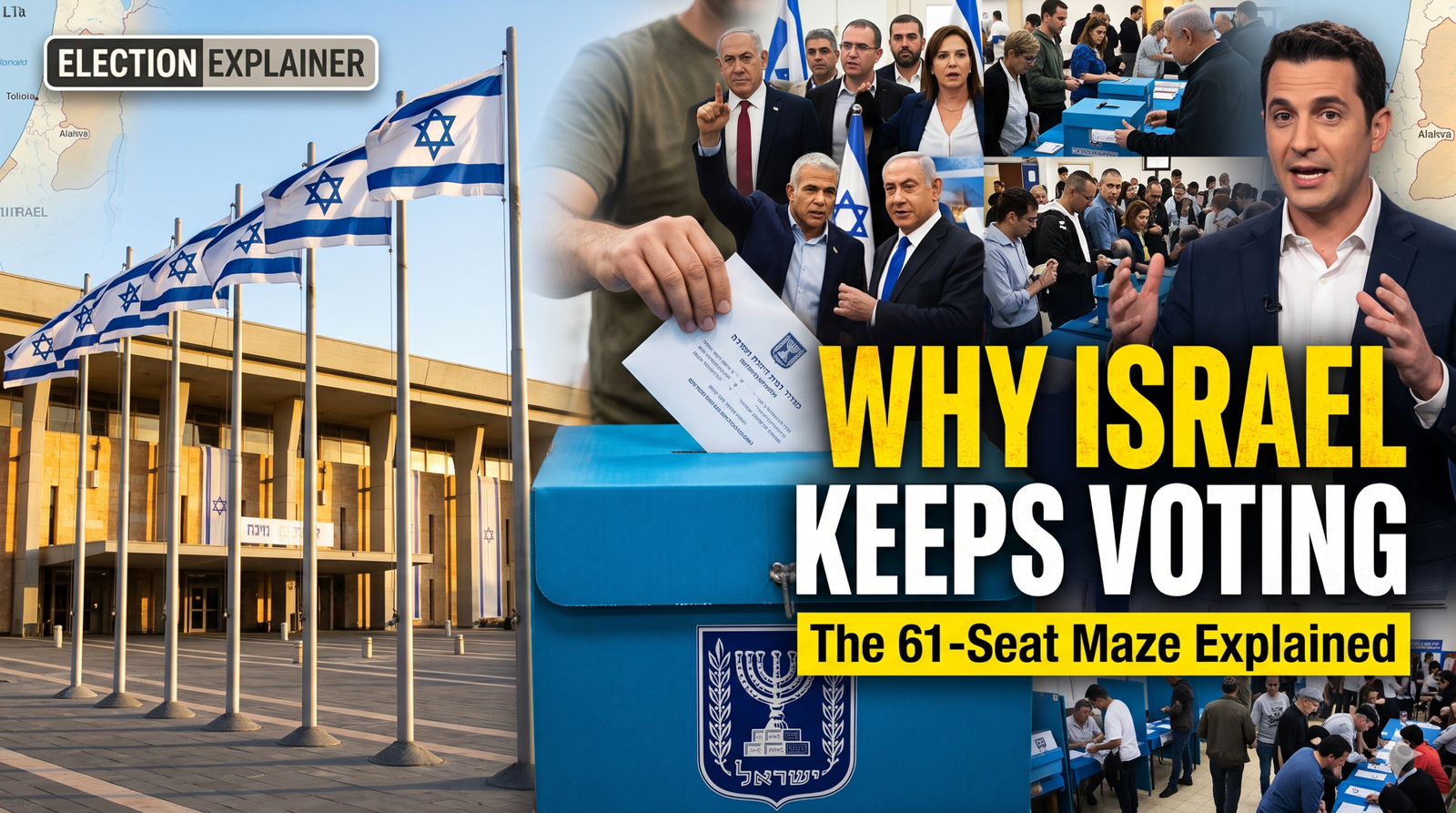
The electoral politics of Israel are among the most dynamic, volatile, and contested in the democratic world. Governed by a parliamentary system anchored in extreme proportional representation, Israel operates without local geographic constituencies; instead, the entire nation forms a single nationwide electoral district. In every election to the 120-seat Knesset, voters cast their ballots for closed national party lists rather than individual candidates.
Because no single political party has ever won an outright 61-seat majority in the country’s history, governance in Israel is intrinsically defined by coalition-building, fragile compromises, ideological fragmentation, and frequent early elections.
1. Mechanics of the Electoral System
The Nationwide Proportional Representation Framework
The foundational architecture of Israeli general elections is laid out in the Basic Law: The Knesset (1958). Every citizen aged 18 or older possesses the right to vote, while citizens aged 21 and over are eligible to run for office.
- Single National District: Unlike democracies that divide representation across geographic constituencies or federal states, Israel treats its entire territory as one voting pool.
- Closed Party Lists: Parties publish ranked rosters of candidates determined either through internal party primaries or committee appointments. If a party earns 10 seats, the top 10 names on its list enter parliament.
- The Electoral Threshold (Akhuz HaHasima): To enter the Knesset, a party list must clear a statutory threshold of the total valid vote (currently set at 3.25%). Votes cast for parties failing to clear this bar are eliminated from the count, often creating dramatic seat redistributions when small factions barely miss the cutoff.
- Seat Allocation: Valid votes cast for qualifying parties are divided according to the Hagenbach-Bischoff quota and the Bader-Ofer method (a variant of the D’Hondt formula), which allocates remaining fractional seats to favor larger party alignments and parties with formal surplus-vote sharing pacts.
The Mandate to Form Government
Following election certification, the President of Israel holds formal consultations with the parliamentary leaders of each party represented in the Knesset. The President subsequently tasks one lawmaker—typically the head of the largest faction or the leader commanding the most formal endorsements—with forming a governing coalition.
The prime minister-designate is granted an initial 28-day window (with a potential 14-day extension) to negotiate a coalition agreement representing at least 61 members of the Knesset. If negotiations collapse, the mandate passes to another candidate or returns to the Knesset plenum; if no majority coalesces, parliament dissolves and voters return to the ballot box.
2. Key Political Blocs and Fault Lines
Israeli electoral politics is defined not along a simple economic left-right axis, but across complex intersecting divisions concerning national security, religious identity, judicial power, and civil rights:
The Right-Wing and Religious Bloc
Led by Likud, Israel’s traditional nationalist right-wing party, this bloc is underpinned by hawkish defense doctrine, skepticism of a Palestinian state, free-market economics, and close political alignment with Orthodox factions. It relies on key coalition allies:
- Haredi (Ultra-Orthodox) Parties: Factions such as Shas (Sephardic Orthodox) and United Torah Judaism (Ashkenazi Orthodox), focused primarily on safeguarding state funding for yeshivas, welfare subsidies, Shabbat enforcement, and exemptions from mandatory military service.
- Religious Zionism & Far-Right: Nationalist factions representing settler interests in the West Bank and advocating for maximalist sovereignty, judicial overhauls, and hardline security postures.
The Centrist and Liberal Opposition Bloc
Comprising parties such as Yesh Atid, Yashar, National Unity, and remnants of the center-left (the Democrats/Labor and Meretz), this camp emphasizes institutional checks and balances, the rule of law, anti-corruption reforms, secular freedoms, and equitable draft obligations across all sectors of society. While heterogeneous on defense and economics, they have predominantly coalesced around resisting democratic backsliding and opposing ongoing governance under Prime Minister Benjamin Netanyahu.
The Arab/Palestinian-Israeli Parties
Representing roughly 20% of Israel’s citizenry, Arab-led factions include Ra’am (United Arab List, an Islamist socially conservative movement) and the secular nationalist Joint List/Hadash-Ta’al. Traditionally consigned to external opposition, Arab parties emerged as decisive powerbrokers in recent cycles. Ra’am’s historic entry into the Bennett-Lapid coalition in 2021 proved that Arab political representation could formally participate in state budgets and policy negotiations, fundamentally transforming coalition arithmetic.
3. Structural Causes of Instability
Israel held five national elections between 2019 and 2022, and parliamentary arithmetic continues to produce narrow, fragile margins. This recurring gridlock stems from structural and societal dynamics:
| Factor | Political Mechanism | Direct Impact on Governance |
| Proportional Dispersal | Low barrier to entry allows small, single-issue parties to gain parliamentary footholds. | Radical or sectorial factions act as coalition “kingmakers,” demanding outsized cabinet portfolios. |
| The “Netanyahu Factor” | The political sphere has polarized into pro-Bibi and anti-Bibi camps, transcending policy. | Traditional center-right and center-left parties refuse to align, forcing reliance on ideological fringes. |
| Haredi Enlistment | Universal conscription disputes pit secular nationalist parties directly against Ultra-Orthodox parties. | Frequent legislative deadlines trigger coalition resignations and early Knesset dissolution. |
| Judicial Overhaul | Deep ideological struggle regarding Supreme Court review over Knesset legislation. | Triggers civic mobilization, nationwide strikes, and severe constitutional impasses between branches. |
4. The Path Forward: Proposals for Electoral Reform
Given that Israeli cabinets rarely survive their full four-year constitutional tenure, political scientists and civil think tanks regularly debate constitutional remedies:
- Raising the Threshold: Proponents argue lifting the electoral threshold to 4% or 5% would eliminate fringe parties and compel ideological mergers, mirroring Germany’s Bundestag model. Opponents caution that higher thresholds disenfranchise minority Arab and progressive factions, driving down turnout.
- Constituency-Based Hybrid Voting: Adopting a system where half the Knesset is elected via local municipal districts and half through national proportional lists. This reform would enhance direct constituent accountability, reducing party leadership hegemony.
- Automatic Prime Ministerial Appointment: Amending the Basic Law so that the leader of the party winning the most votes automatically becomes prime minister, removing months of inter-party horse-trading.
Ultimately, Israel’s electoral system functions as an exact mirror of a deeply pluralistic, highly mobilized, and fragmented society. While the country’s proportional model guarantees broad democratic representation for disparate demographic groups—from secular tech workers and kibbutzniks to Haredi scholars and Arab citizens—it continues to trade executive stability for parliamentary inclusivity, keeping Israeli democracy in a perpetual state of political negotiation.