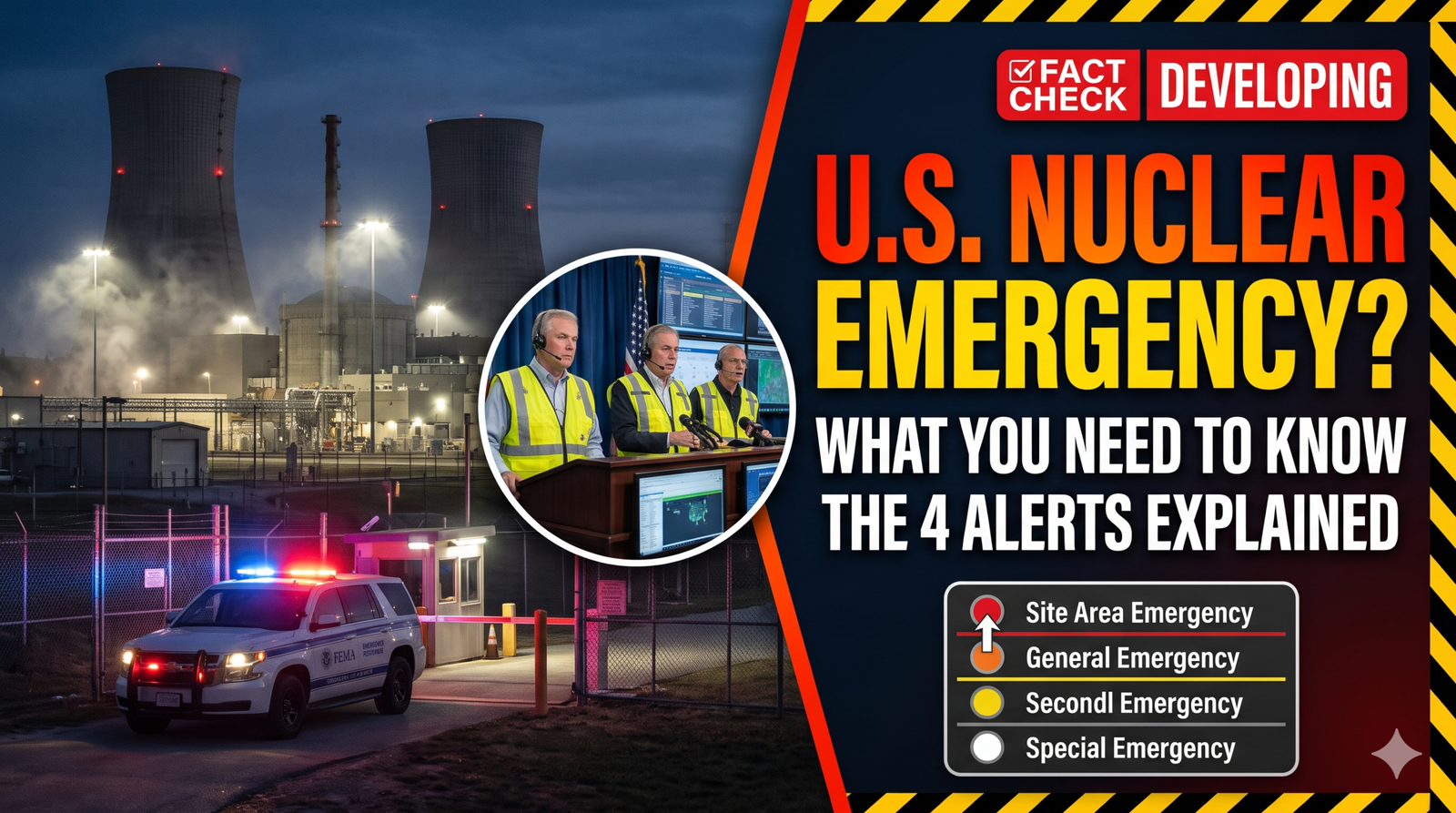
If you are referring to breaking reports about a US nuclear emergency declaration, headlines often conflate localized regulatory safety alerts—such as the recent Site Area Emergency triggered at the Department of Energy’s Savannah River nuclear facility in South Carolina—with a nationwide radiological crisis.
The United States has not declared a countrywide nuclear disaster or state of war. Instead, nuclear emergencies in the U.S. operate under a strict, standardized hierarchy managed by the Nuclear Regulatory Commission (NRC), the Department of Energy (DOE), and the Federal Emergency Management Agency (FEMA).
Clarifying the Alert: What Triggered Recent Headlines
On October 28, 2026, the U.S. Department of Energy declared a Site Area Emergency at the Savannah River Site (SRS) complex near Aiken, South Carolina. The incident originated from a localized fire within the Savannah River National Laboratory (SRNL).
- Immediate Containment: The declaration automatically prompted on-site shelter-in-place orders for non-essential staff, site barricades, and temporary transit restrictions across adjacent air, rail, and river corridors.
- Resolution and Verification: On-site emergency crews contained and extinguished the fire within two hours. Extensive ground and radiological surveys verified zero detectable off-site radiation leaks, and authorities terminated the emergency by 9:45 PM that same evening.
While alarming in news tickers, this declaration represents standard, protocol-driven emergency management designed to contain industrial incidents at federal nuclear facilities.
The Four Official Nuclear Emergency Classifications in the U.S.
Under Title 10 of the Code of Federal Regulations (10 CFR 50.72 and 50.47), commercial nuclear power plants and federal research facilities classify events into four escalating categories:
┌────────────────────────────────────────────────────────┐
│        NRC / DOE EMERGENCY ACTION LEVEL HIERARCHY       │
├────────────────────────────────────────────────────────┤
│ 1. Notification of Unusual Event (Lowest)              │
│ 2. Alert                                               │
│ 3. Site Area Emergency (Facility perimeter actions)    │
│ 4. General Emergency (Potential off-site release)      │
└────────────────────────────────────────────────────────┘
1. Notification of Unusual Event (NOUE)
This is the lowest operational classification. It signals a minor anomaly or unplanned operational event indicating a potential degradation in plant safety.
- Public Impact: None. No radioactive release occurs.
- Protocol: Plant operators notify the NRC and state/local emergency agencies within 15 to 60 minutes to establish initial communication channels.
2. Alert
An Alert indicates events that involve an actual or potential substantial degradation in the level of plant safety, or an on-site security threat.
- Public Impact: Minimal to none. Any potential radiological release is expected to remain well below federal off-site exposure limits.
- Protocol: On-site Emergency Response Facilities (Technical Support Center, Operations Support Center) are fully staffed, and regional civil defense coordinators are placed on standby.
3. Site Area Emergency (SAE)
A Site Area Emergency involves major failures of plant functions needed for protection of the public, or serious security events that could affect plant safety.
- Public Impact: Off-site radioactive releases are not expected to exceed Environmental Protection Agency (EPA) Protective Action Guides beyond the facility boundary.
- Protocol: Sirens may be activated to notify residents within the 10-mile Emergency Planning Zone (EPZ) to tune into local broadcast channels. On-site non-essential staff evacuate or shelter, and local access roads are restricted.
4. General Emergency (GE)
The most severe classification. A General Emergency involves actual or imminent substantial core degradation or melting with the potential for loss of containment integrity.
- Public Impact: Radioactive releases can exceed federal protective guidelines off-site.
- Protocol: Pre-determined Protective Action Recommendations (PARs) are immediately issued to local state governors. Typical measures include 360-degree sheltering-in-place or staged evacuations within key 2-to-5-mile sectors, extending downwind out to 10 miles.
Federal Command and Response Architecture
When a significant nuclear emergency occurs, authority transitions from facility operators to a coordinated federal response framework:
- Nuclear Regulatory Commission (NRC): Maintains headquarters operations centers in Rockville, Maryland. In serious incidents, the NRC activates its Executive Team, sends an Incident Response Team directly to the control room, and assumes federal technical oversight.
- Federal Emergency Management Agency (FEMA): Coordinates off-site consequence management, directing evacuation corridors, sheltering shelters, emergency alerts (EAS/WEA), and mutual aid through the National Response Framework (NRF).
- National Nuclear Security Administration (NNSA): Mobilizes specialized scientific units, notably the Nuclear Emergency Support Team (NEST), Atmospheric Release Advisory Capability (NARAC), and Radiological Assistance Programs (RAP) for aerial radiation mapping and isotope identification.
- Department of Health and Human Services (HHS / FDA / CDC): Manages the distribution of the Strategic National Stockpile, including medical countermeasures such as Potassium Iodide (KI) to block radioactive iodine uptake in the thyroid, and decorporation agents like Prussian Blue.
Standard Public Safety Protocols
Federal guidelines establish clear instructions for the public in the rare event of a declared General Emergency:
- Get Inside: Move into the nearest concrete, brick, or subterranean structure. Dense building materials significantly block gamma radiation.
- Stay Inside: Close all exterior doors and windows; shut off HVAC units, fireplaces, and air intakes that draw in outside air.
- Decontaminate if Exposed: Remove outer clothing and seal it in plastic bags; take a gentle shower with mild soap without scrubbing the skin.
- Follow Official Broadcasts: Do not evacuate prematurely. Unauthorized “shadow evacuations” clog vital transit corridors required for emergency services and high-risk evacuees. Only ingest Potassium Iodide (KI) tablets when explicitly directed by public health officials.
Localized emergency declarations are rapid-response administrative mechanisms designed to ensure public transparency and test site containment.
For visual coverage of the Savannah River nuclear site incident and the response protocols deployed during the alert, check out Savannah River Nuclear Site Emergency Coverage
.
This video provides on-the-ground reporting and official statements regarding the lab fire and the lifting of the site emergency.